Bret Alexander Beheim
Group Leader, Models of Sociality, Art, Information and Culture (MOSAIC) Research Group
Department of Human Behavior, Ecology, and Culture
Max Planck Institute for Evolutionary Anthropology, Leipzig
I study cultural evolution: how information, behavior, technology, and institutions spread, persist, and change in human populations. My work combines mathematical models with large-scale behavioral and historical datasets, longitudinal field research, and computational methods. I am also interested in the intersection of social learning and demography.
A second part of my research focuses on the infrastructure of science itself. I develop tools and workflows for longitudinal databases and open, reproducible scientific analyses for a number of long-running collaborative field projects.
I received my Ph.D. in Ecology from the University of California, Davis, and have been at the Max Planck Institute for Evolutionary Anthropology since 2016. I have led the MOSAIC Research Group since 2020.
Curriculum vitae · Google Scholar · ORCID · GitHub · Email
Research
My research focuses on how individual decisions scale up to population-level patterns of cultural diversity. I work on both theoretical and empirical projects that try to connect learning strategies and innovation to demographic, ecological and social processes.
Mathematical models of cultural evolution
My current theoretical work focuses on the interaction between learning strategies, demographic turnover, population structure, and changes in the information environment. This relies heavily on formal mathematical models and computational and simulation-based inference.
In particular, I focus on decomposing cultural change into distinct evolutionary forces, on analyzing the relationship between population segmentation and group-beneficial traits, and modeling the cultural transmission of behavior across the life course. This also provides the basis for my current book with Paul Smaldino, Mathematical Foundations of Cultural Evolution.
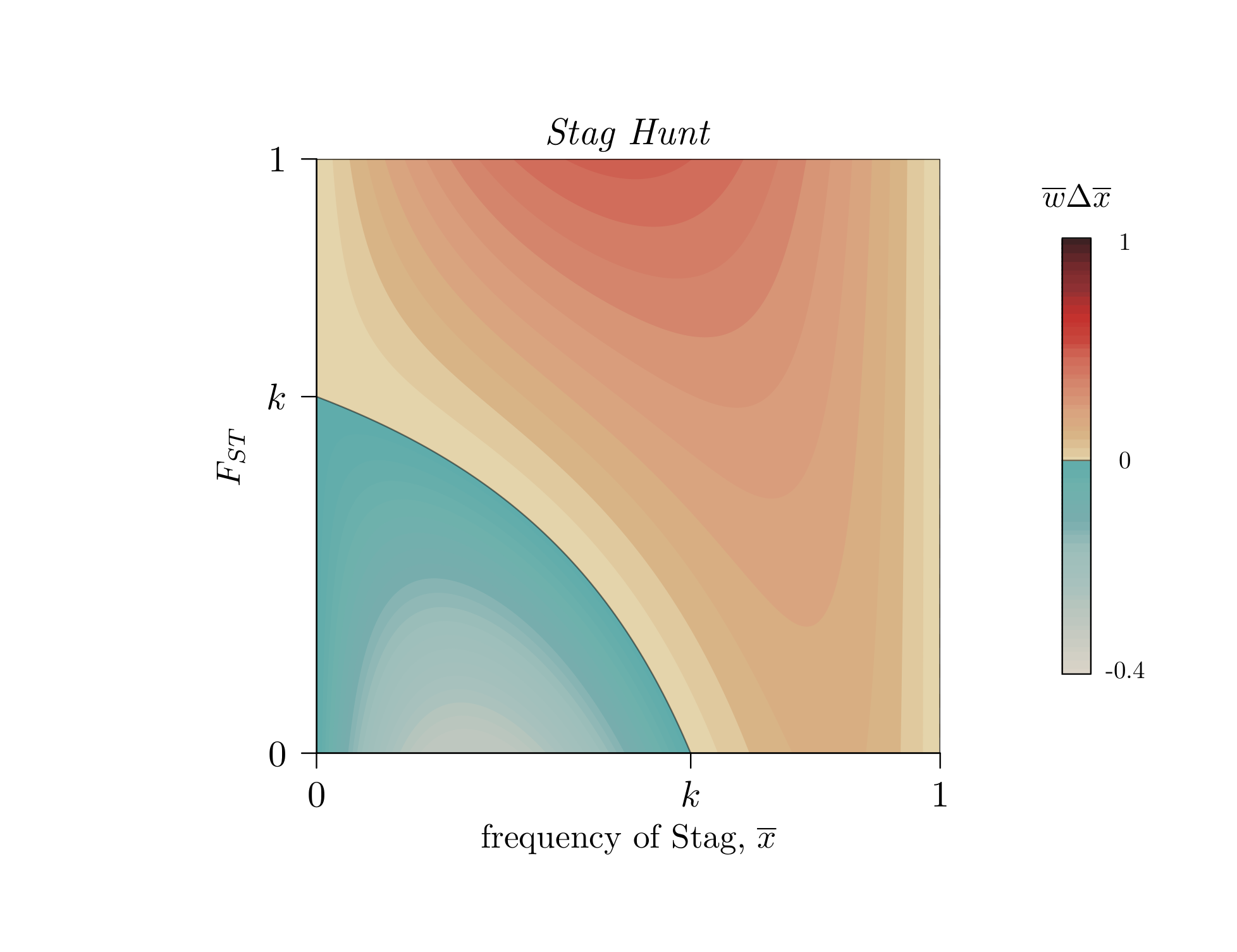
Selection diagram for cooperation in a metapopulation Stag Hunt game
Representative work includes Does literature evolve one funeral at a time?, Why cultural distance can promote – or impede – group-beneficial outcomes, and The development of risk behaviors and their cultural transmission.
Empirical cultural dynamics and human ecology
I study cultural and social change using historical and contemporary datasets, from cognitive learning biases to long-term, population-wide diffusion dynamics. I draw on the idioms and tools of human evolutionary ecology, and employ statistical modeling to ask questions of the data about the forces driving cultural evolution. These questions are largely drawn from evolutionary theory, and more specifically, formal theories of cultural evolution.
I am also very interested in the role of information infrastructure in shaping the speed and nature of cultural change. One long-running example is the East Asian board game Go (a.k.a. Baduk or Weiqi), where centuries of records of professional play make it possible to observe strategic social learning and the turnover of specific cultural variants over different historical eras, most recently including the transition into the era of superhuman artificial intelligence. The data and analysis for my recent work on this transition are openly available in the go-learning-eras repository, while the kaya R package provides reusable tools for parsing and analyzing Go game records.
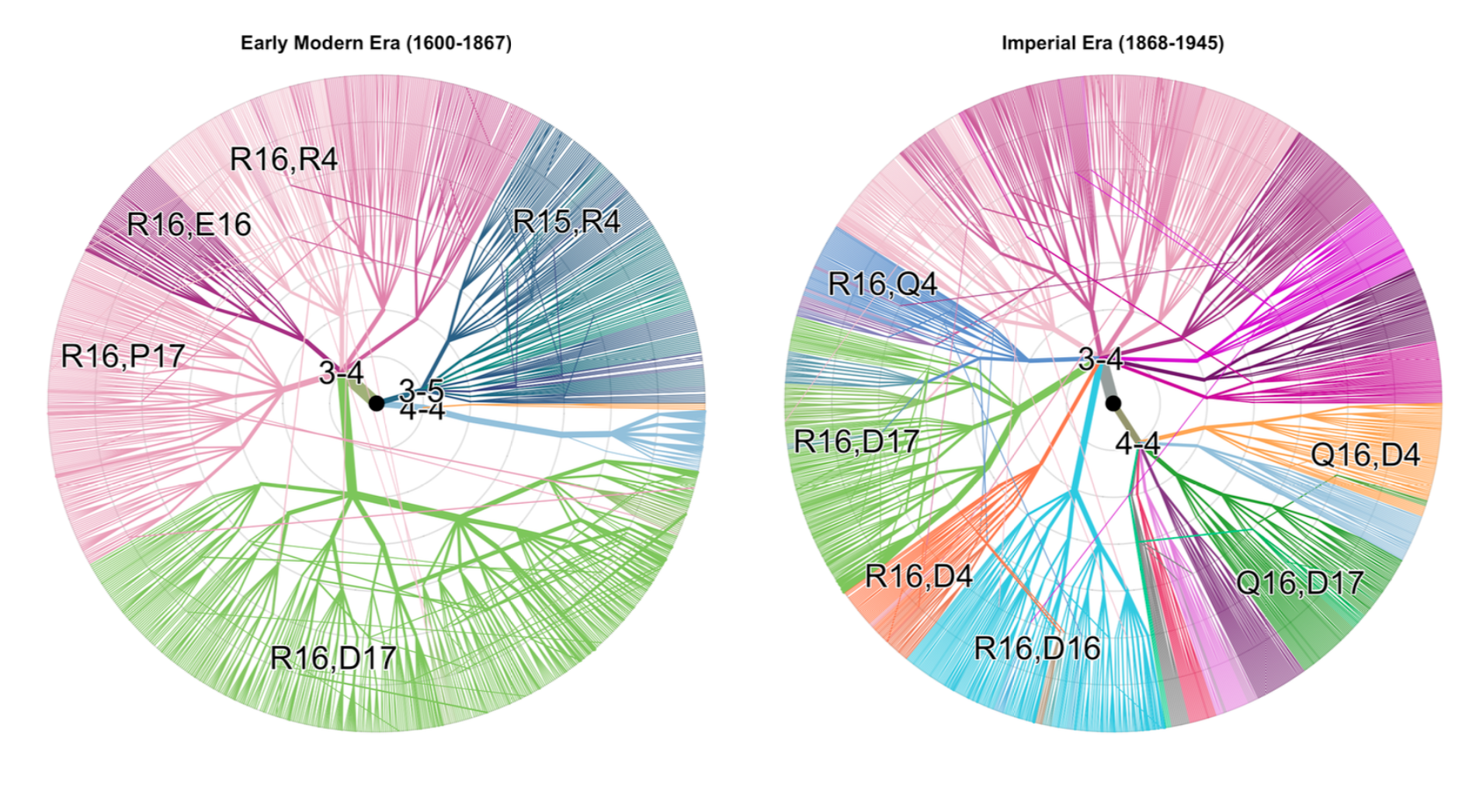 Change in Go opening strategies over time.
Related projects have examined the structure of Tamil kolam art, residential mobility in historical European populations, the turnover of literary forms, and the effects of cultural and social structure on cooperation and inequality.
Since 2012, I have also worked with the Tsimane Health and Life History Project in Bolivia. This collaboration focuses on market integration, mobility, social networks, health, demography, and the diffusion of technologies and practices in a rapidly changing small-scale society. As part of this project, I have made important contributions to empirical research on cooperation, cardiovascular health, infectious disease, aging, wealth, reproduction, and demographic change.
Data provenance, research infrastructure, and open science
Large longitudinal datasets make it possible to address questions that cannot be studied with small cross-sectional samples, but they also face novel problems related to data provenance, data integrity, and long-term reproducibility. In addition to my primary focus as a researcher, I develop research infrastructure to make complex field data easier to maintain and use.
I have been the primary database developer and maintainer for the Tsimane Health and Life History Project since 2012, and have contributed to data-management workflows at multiple research fieldsites. This work has also motivated empirical research on the effective reproductibility of scientific results in the fields of human and nonhuman social learning and primate cognition.
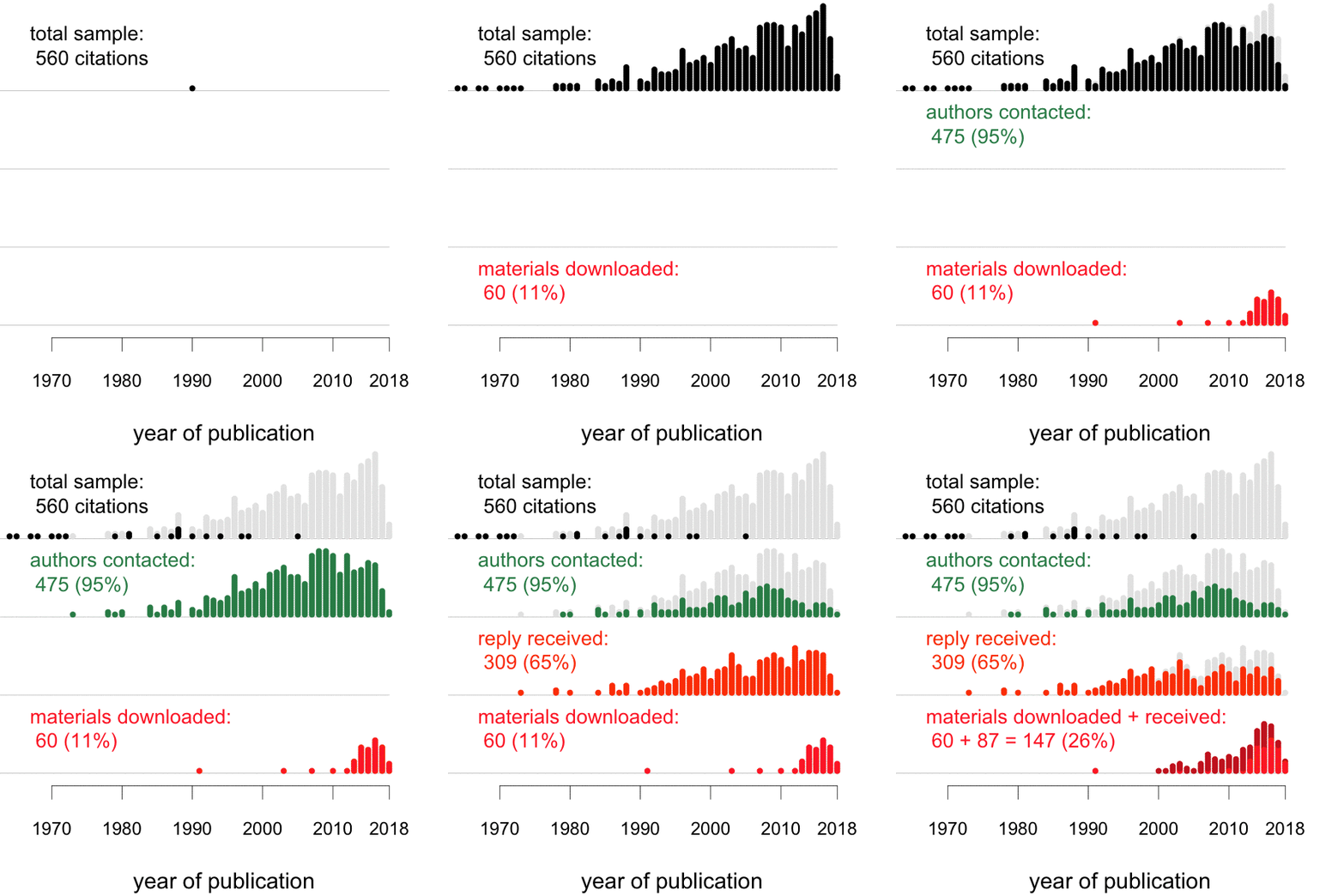
Availability of social learning data by publication year
Representative work includes Estimating the reproducibility of social learning research published between 1955 and 2018, The Tsimane Health and Life History Project: Integrating anthropology and biomedicine, and Reproducible Research as our New Default. A large-scale example of this approach is the reanalysis repository for our Nature Matters Arising on the rise of moralizing religious beliefs in world history.
Book
Mathematical Foundations of Cultural Evolution
Bret Beheim and Paul E. Smaldino
Under contract with Princeton University Press · manuscript due December 2026
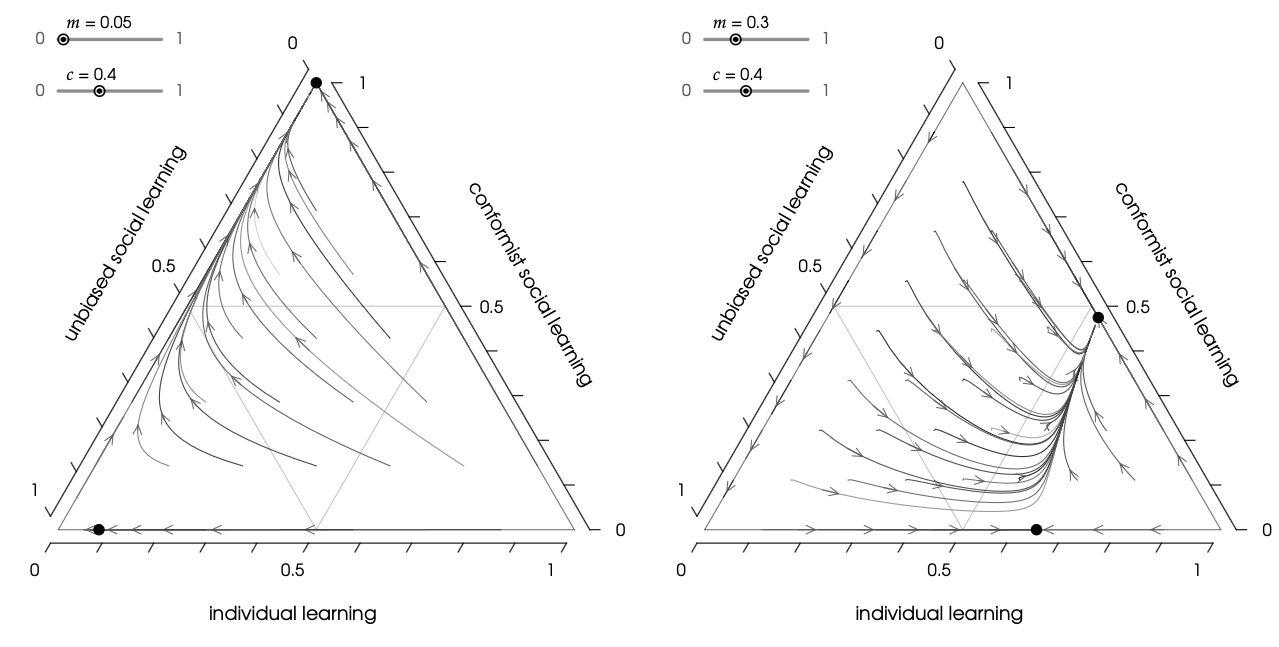
Modeling the evolution of social learning strategies.
We are writing a book-length introduction to the mathematical foundations of cultural evolution. Starting from first principles, the book derives, step by step, the key formal models for how socially transmitted information changes in populations and connects those models to the broader logic of evolutionary, ecological, and demographic processes. Our aim is to make the mathematical structure of cultural-evolution models transparent and up-to-date for contemporary researchers, as well as highlight different assumptions in the literature about cognition, learning, population structure, demography, and environmental change.
Publications
A selection of recent and representative work is below. Also available is my complete publication list, my CV and Google Scholar profile.
— PDF
— data / code
— citation (BibTeX)
-
Alejandro Pérez Velilla, Bret A. Beheim, Paul E. Smaldino (2025). The development of risk behaviors and their cultural transmission. Psychological Review.
-
Claudia A. F. Wascher, Gemini Waterhouse, Bret A. Beheim (2025). Vocal mimicry in corvids. Animal Cognition, 28(1), 88.
-
Bret A. Beheim (2025). Opening strategies in the game of Go from feudalism to superhuman AI. Evolutionary Human Sciences, 7, e28.
-
Oleg Sobchuk, Bret A. Beheim (2025). Does literature evolve one funeral at a time?. Proceedings of the Royal Society B: Biological Sciences, 292(2040), 20242033.
-
Jordan S. Martin, Bret A. Beheim, Michael Gurven, Hillard Kaplan, Jonathan Stieglitz, Benjamin C. Trumble, Paul Hooper, Dan Cummings, Daniel Eid Rodriguez, Adrian V. Jaeggi (2025). Indirect genetic effects among neighbors promote cooperation and accelerate adaptation in a small-scale human society. Science Advances, 11(31), eads3129.
-
Elspeth Ready, Cody T. Ross, Bret A. Beheim, Jenn Parrott (2024). Indigenous food production in a carbon economy. Proceedings of the National Academy of Sciences, 121(32), e2317686121.
-
Bret A. Beheim, Adrian Viliami Bell (2024). Why cultural distance can promote – or impede – group-beneficial outcomes. Evolutionary Human Sciences, 6, e14.
-
Natalia Fedorova, Richard McElreath, Bret A. Beheim (2022). The complex life course of mobility: Quantitative description of 300,000 residential moves in 1850–1950 Netherlands. Evolutionary Human Sciences, 4, e39.
-
Riana Minocher, Silke Atmaca, Claudia Bavero, Richard McElreath, Bret A. Beheim (2021). Estimating the reproducibility of social learning research published between 1955 and 2018. Royal Society Open Science, 8(9), 210450.
-
Bret A. Beheim, Quentin D. Atkinson, Joseph Bulbulia, Will Gervais, Russell D. Gray, Joseph Henrich, Martin Lang, M. Willis Monroe, Michael Muthukrishna, Ara Norenzayan, Benjamin Grant Purzycki, Azim Shariff, Edward Slingerland, Rachel Spicer, Aiyana K. Willard (2021). Treatment of missing data determined conclusions regarding moralizing gods. Nature, 595(7866), E29–E34.
-
Hillard Kaplan, Randall C. Thompson, Benjamin C. Trumble, L. Samuel Wann, Adel H. Allam, Bret A. Beheim, Bruno Frohlich, M. Linda Sutherland, James D. Sutherland, Jonathan Stieglitz, Daniel Eid Rodriguez, David E. Michalik, Chris J. Rowan, Guido P. Lombardi, Ram Bedi, Angela R. Garcia, James K. Min, Jagat Narula, Caleb E. Finch, Michael Gurven, Gregory S. Thomas (2017). Coronary atherosclerosis in indigenous South American Tsimane: a cross-sectional cohort study. The Lancet, 389(10080), 1730–1739.
-
Bret A. Beheim, Calvin Thigpen, Richard McElreath (2014). Strategic social learning and the population dynamics of human behavior: the game of Go. Evolution and Human Behavior, 35(5), 351–357.
Group
I supervise students and postdoctoral researchers through the MOSAIC (Models of Sociality, Art, Information and Culture) group in the Department of Human Behavior, Ecology, and Culture at MPI-EVA. My mentoring has centered on cultural evolution, information diffusion, longitudinal data analysis, and reproducible research.
Research Team
- Peeter Tinits, postdoctoral researcher
- Oleg Sobchuk, postdoctoral researcher; now Independent Group Leader, Max Planck Institute for Empirical Aesthetics
- Daniel Redhead, postdoctoral researcher; now Assistant Professor at the University of Groningen
- Natalia Fedorova, doctoral researcher; now Assistant Professor at Aarhus University
- Riana Minocher, doctoral researcher; now Research Fellow at the Berlin Institute of Health at Charité
- N.-Han Tran, doctoral researcher; now Head of Unit, Microcensus Analysis, at the Federal Statistical Office of Germany
- Anja Becker, B.A. and M.Sc. theses, Leipzig University
- Leonie Ette, M.A. thesis, Leipzig University
I also coordinate and contribute to research infrastructure for collaborative field projects through the department’s data-provenance work, and have directly supervised a team of 18 research assistants in Leipzig and 12 in Bolivia.
Teaching
My teaching, both at a graduate and undergraduate level, focuses on topics in cultural evolution, behavioral ecology, and quantitative method.
Scientific Computing in Evolutionary Anthropology
Since 2019 I have designed and taught an annual course on scientific computing at MPI-EVA, with an emphasis on reproducible workflows, version control, data organization, automation, testing, and transparent analysis drawing on the Software Carpentry curriculum.
Previous courses
As the primary instructor, I have designed and taught a number of courses over the years on cultural evolution, behavioral and cultural ecology, human evolution, statistics, applied probability theory, and research methods to both graduate and undergraduate students.
- The Human Life Course, University of New Mexico, 2013–2015
- Research Computing in Evolutionary Anthropology, University of New Mexico, 2014 (co-led with Jeff Long)
- Workshop on Statistical Rethinking, University of New Mexico, 2016
- Evolution and Human Nature, University of California, Davis, 2011
- Applied Research Methods, University of California, Davis, 2011–2012
- Cultural Ecology, University of California, Davis, 2010 (co-led with Ben Orlove)
Software
I develop reusable research software and publish the code and materials behind almost all of my empirical work. My goal is not only to build infrastructure that can be reused across studies, but also to make any specific analysis reproducible.
Research software
- longformer — tools for managing longitudinal relational research databases in R; used to manage the Tsimane Health and Life History Project Research Database
- kaya — tools for parsing, validating, transforming, and analyzing Go games stored in SGF format
- yamltools — tools for parsing YAML-structured plaintext interview data
- yamlform — a plaintext interview format for producing XLSForm documents for ODK-based data collection
- SIMani — agent-based simulation of demographically realistic human populations
Selected reproducible research
- go-learning-eras — data and analysis code for Opening strategies in the Game of Go from feudalism to superhuman AI
- causality-variance-fst — models, analysis, and figure-generation code for Why cultural distance can promote – or impede – group-beneficial outcomes
- moralizing-gods-reanalysis — the reproducible computational archive for our Nature reanalysis of missing data and moralizing-gods claims
I also build smaller tools and visualizations for communicating research methods, including citation-gates, which visualizes how cited results pass through successive reproducibility checks.
All software repositories, with annotation
Scientific visualization gallery
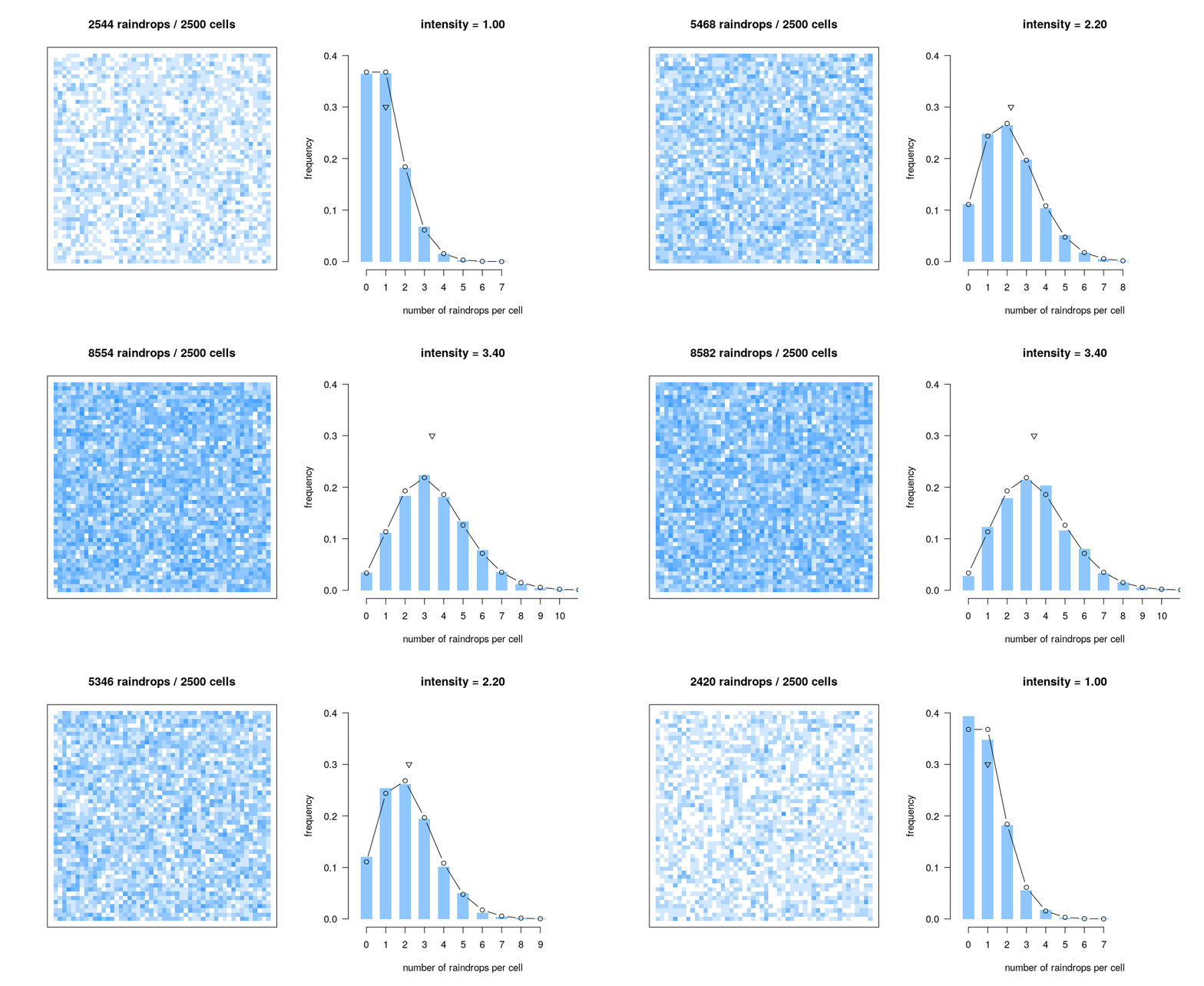
Demonstration of the Poisson scatter theorem.
For my teaching and research materials, I often create animated, colorful visualizations to help communicate some idea using code. A collection of my favorite visualizations, alongside reproducible code snippets, is here.